

Agda Holst (1888-1976)
Price:15500 SEK1380 EUR1488 USDChange Currency
Dimensions: Height 65 cm (26 inches) x Width 55 cm (22 inches)
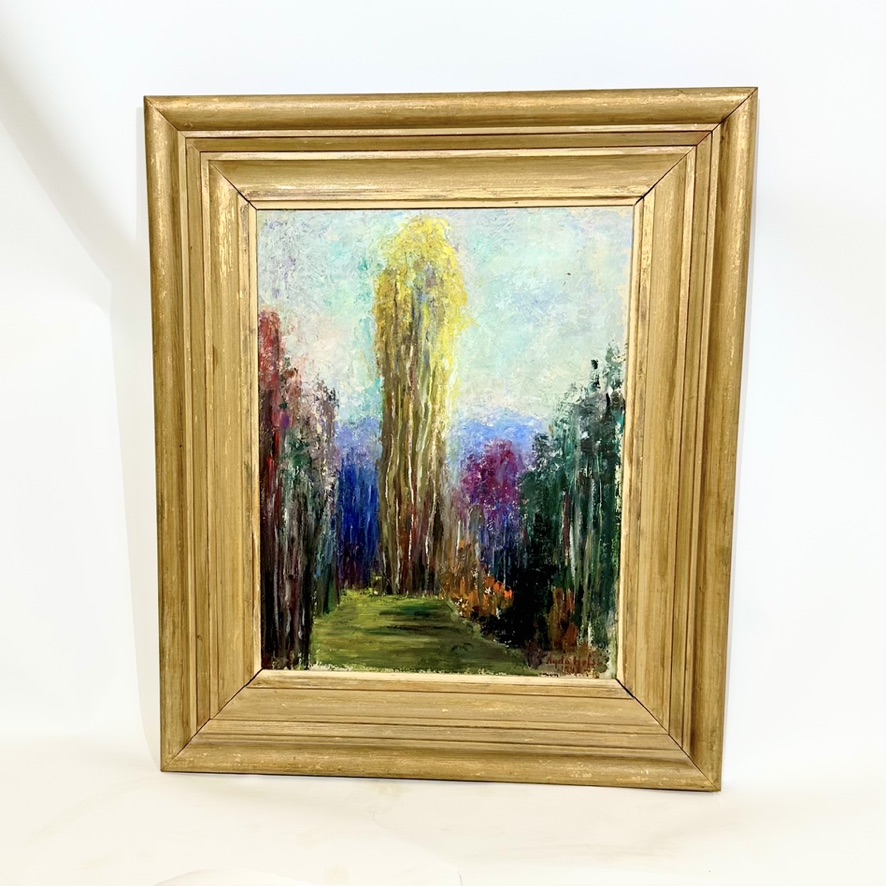
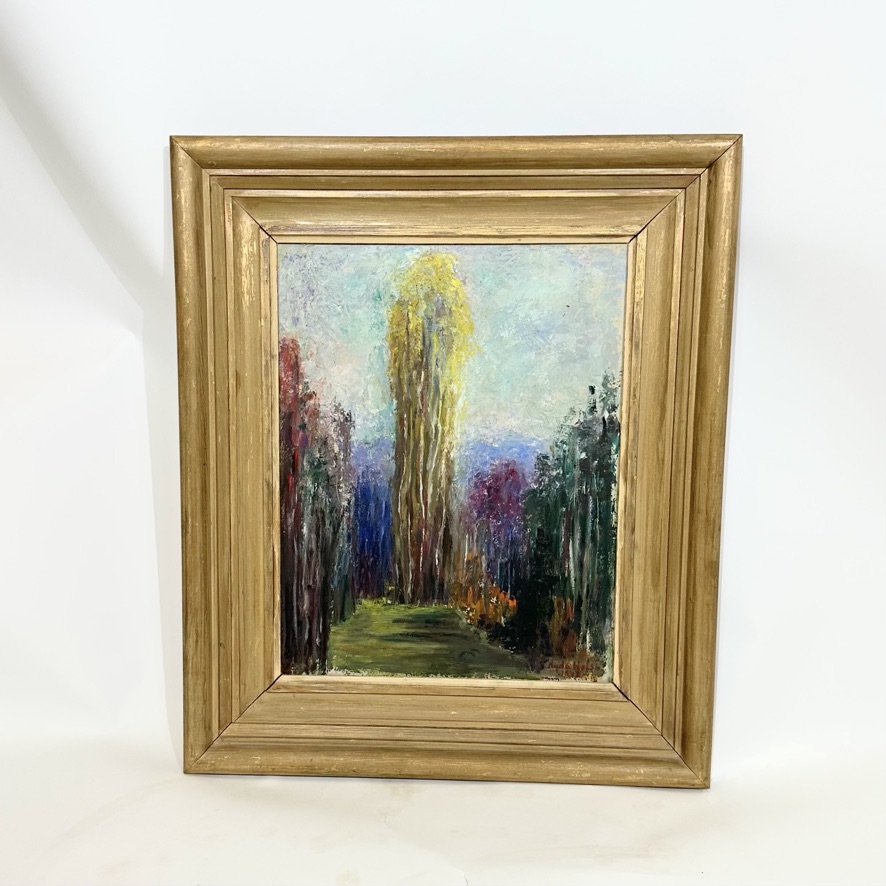
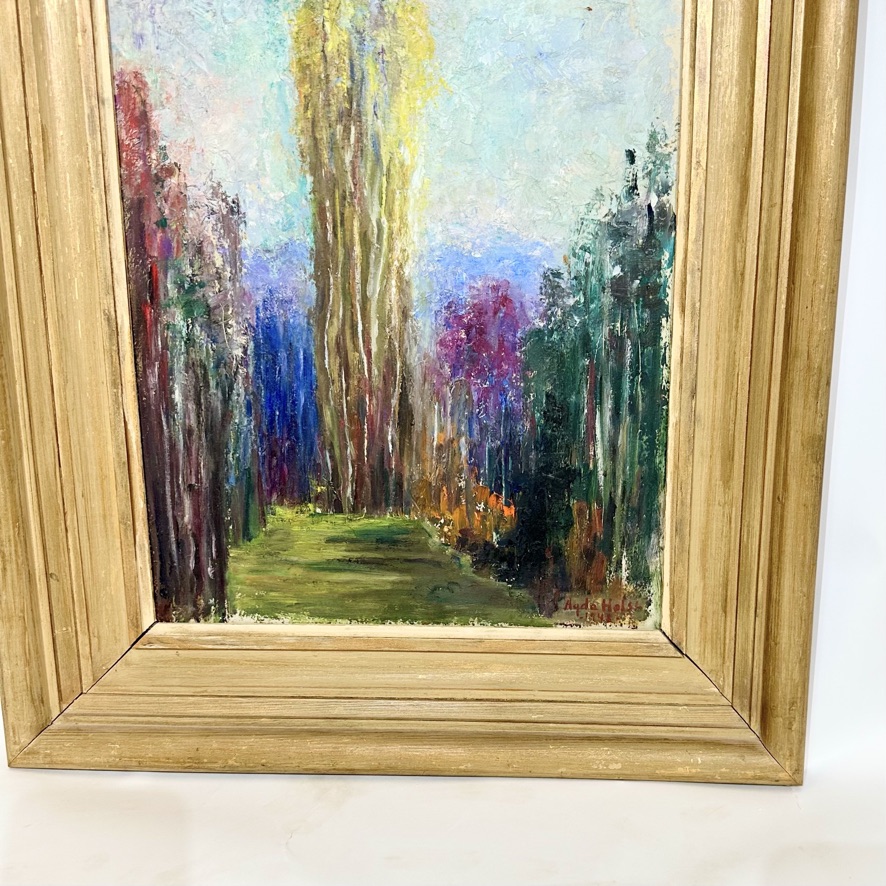
A vibrant painting depicting an avenue lined with poplar trees in fall colors, prominently featuring a very large, centrally placed yellow poplar. Possibly an American poplar. The artist, Agda Holst, has employed a diverse palette of colors to the poplars, creating a dynamic and colorful composition. This oil on panel is signed and dated by Holst in 1948. The work exemplifies her use of color and form, characteristics that defined her artistic practice throughout her career. Agda Holst was a Swedish modernist painter known for her precise study of form, stylized compositions, and ability to merge structured geometry with expressive color. Her works, often still lifes, portraits, and figure studies, reflect a balance between naturalistic representation and modernist influences such as Cubism and New Objectivity. Holst's artistic journey began in 1907 at the Académie Colarossi in Paris, where she studied under Christian Krohg. Seeking further refinement, she moved to Munich between 1910 and 1911, studying with Julius Exter, known for his teachings in portrait and genre painting. In 1911–1912, she returned to Paris to study under Kees van Dongen, whose bold use of color and strong contrasts left a lasting impression on her work. The early 1920s marked another period of study in Paris, this time under André Lhote, who instilled in her a structured approach to composition and geometric clarity. Holst’s first public exhibition took place in 1916, when she displayed paintings in a bookstore window in Kristianstad. Her official debut followed at Skånes konstförening in Malmö. By the late 1920s, she had established herself as a professional artist, holding her first solo exhibition at Lund University’s Art Museum in 1927. This success led to portrait commissions. Throughout her career, Holst exhibited widely, with solo shows in Skåne and participation in group exhibitions in Stockholm, Copenhagen, Bordeaux, and New York. In 1931, she held a significant solo exhibition at Malmö City Hall, followed by a show at Gothenburg’s Art Hall in 1932, where her self-portrait At the Easel received critical acclaim. Her works were also featured at the Salon des Indépendants in Bordeaux. Despite being the only woman in the male-dominated artist collective Aura, founded in 1928, Holst was highly respected by her colleagues. Unlike many female artists of her time, she was treated as an equal by her male peers, who recognized her talent and professionalism. Her work evolved throughout her career, moving from precisely structured portraits to more expressive and textured compositions. The late 1930s saw an increased focus on still lifes, where she explored the interplay of form and color in a Cubist-influenced style. Her 1948 painting of the poplar-lined avenue exemplifies her mature artistic voice, where vibrant hues and dynamic composition come together in a striking yet harmonious manner. In 1945, Kristianstad’s museum held a retrospective exhibition celebrating 40 years of Holst’s work, tracing her artistic evolution from academic studies to modernist expression. By this time, she had gained the financial freedom to paint without commercial constraints, allowing her work to take on a more introspective and experimental tone. Many of her later works became increasingly expressive, with biblical themes, palette knife techniques, and sketch-like compositions. In 1964, she was awarded Kristianstad’s first cultural prize, and in 1965, a retrospective exhibition at the city’s museum further solidified her legacy. As her eyesight deteriorated in later years, she adapted her technique, working more with pastels. Agda Holst passed away in 1976 in her lifelong home in Kristianstad. Her influence on Swedish modernism remains significant, and her works continue to be displayed in posthumous exhibitions.